Home / Insights / AI adoption

AI & organisational capability

AI adoption is a capability, not a software launch.

Sustainable adoption means people can use AI appropriately in real work, leaders can govern it, and the organisation can learn from evidence over time.

The core idea

What does organisational AI capability mean?

Organisational AI capability is the repeatable ability to select appropriate uses of AI, apply them within defined workflows, manage their risks, judge their outputs and improve the way people and systems work together. It is broader than access to a model and more demanding than attendance at a training session.

A capable organisation connects five things: a valuable use case, competent users, a workable process, proportionate governance and evidence of performance. If one is missing, adoption can remain informal, fragile or difficult to scale.

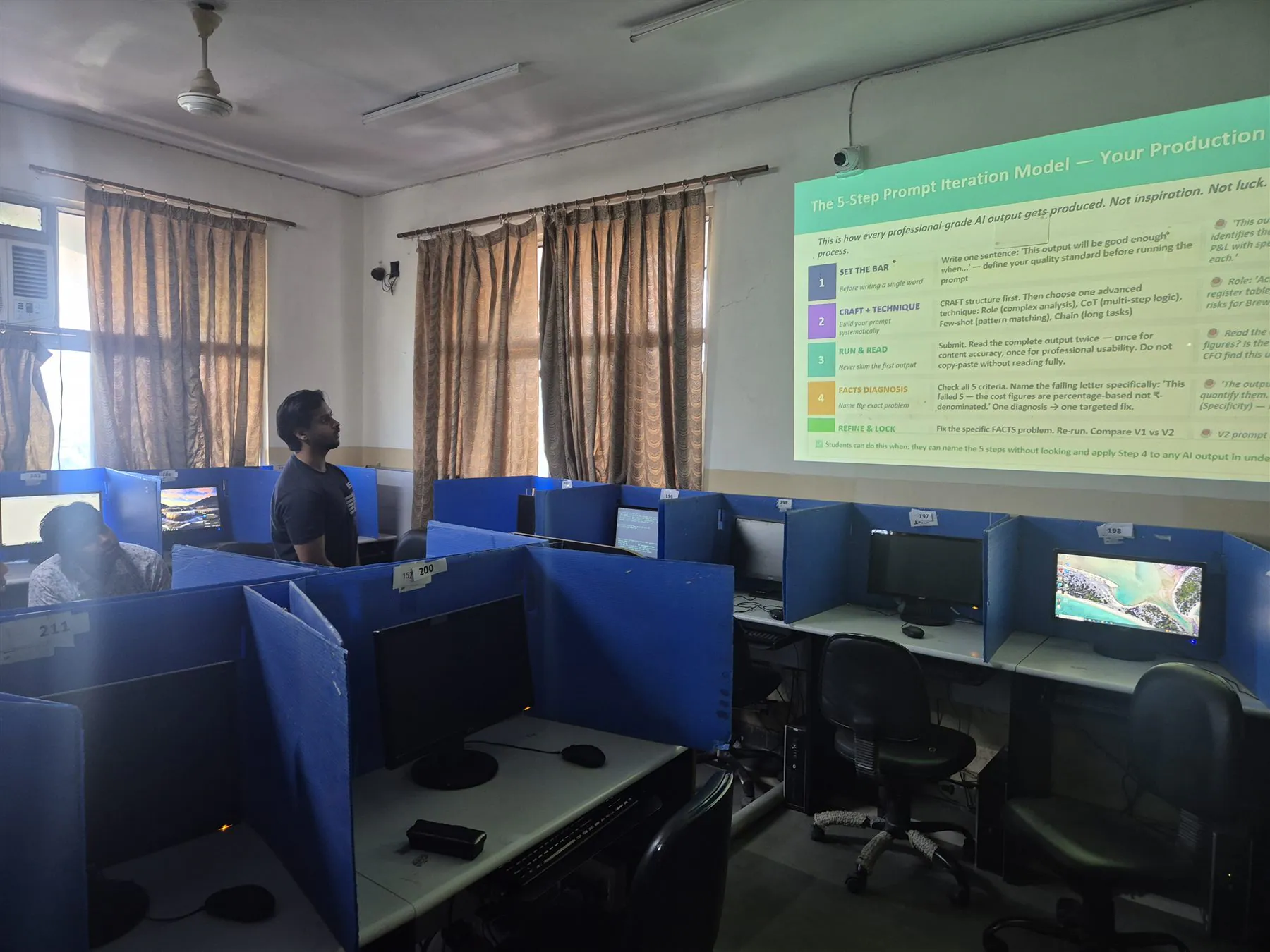
Participants applying AI tools during a facilitated session in a computer laboratory
Practice in contextCapability becomes visible when people can make sound decisions with AI in the workflow where it will be used.

A practical capability model

Build the system around the use case.

The NIST AI Risk Management Framework Core organises risk work around Govern, Map, Measure and Manage. NIST also stresses that these functions are not a simple checklist or fixed sequence. That is useful for adoption: governance should shape the work from the start, while mapping, measurement and management continue through the lifecycle.

Purpose and context

Start with a decision or task.

Name the user, workflow, intended benefit, affected people and constraints. Describe what the AI may do, what it must not do and where a person remains responsible. A broad instruction to “use AI” is not an operational use case.

Practice and judgement

Develop role-specific ability.

Users need to frame inputs, inspect outputs, recognise uncertainty, protect information and escalate concerns. Managers need to set boundaries and review evidence. Technical teams need to understand integration, monitoring and failure modes.

Ownership and learning

Create a durable operating routine.

Assign a use-case owner, risk and data responsibilities, review points and a route for incidents or feedback. Capture what changes in the workflow, then update guidance and training as the technology and context change.

From experiment to adoption

Use evidence gates instead of enthusiasm.

A pilot should answer whether a use case deserves to proceed, under what conditions and with which controls. The decision is stronger when the team agrees the evidence before testing begins.

1. Define the work and boundary

Describe the current task, user need and pain point. Separate the output the AI produces from the decision a person or system makes next. Record excluded uses, sensitive information, legal or policy constraints and the minimum acceptable quality. This creates a shared basis for design and review.

2. Map value, people and risk

Identify who benefits, who could be affected, what data or third-party services are involved and how failure would be noticed. The NIST Core explicitly calls for documented application scope, human oversight and consideration of third-party components. Mapping should involve operational users and affected perspectives, not only the implementation team.

3. Practise with authentic tasks

Provide a safe setting in which users perform realistic work, compare outputs and explain their decisions. Training should be close enough to the actual role that evidence can transfer. This reveals gaps in instructions, access, judgement and workflow design that a generic demonstration will not expose.

4. Measure the combined system

Assess more than model output. Review task quality, error patterns, human corrections, time and effort, user understanding, affected-user feedback, policy compliance and escalation behaviour where relevant. Measures should match the use case and risk; a low-stakes drafting aid and a consequential recommendation require different assurance.

5. Decide, govern and improve

Use the evidence to continue, change, limit or stop the use case. Document ownership, approved conditions, monitoring frequency and the response to incidents or material changes. Adoption becomes institutional when the organisation can repeat this cycle without depending on one enthusiastic individual.

What good evidence looks like

Separate activity, capability and organisational conditions.

Evidence should show what people can do and whether the surrounding system supports reliable use. Completion counts may describe reach, but they do not establish that a role can use AI well in practice.

User capability

Can the role perform and explain the work?

Useful evidence can include observed tasks, reviewed work products, decisions with stated reasoning, correct use of escalation routes and repeated performance across realistic cases. The standard should be explicit enough for two reviewers to discuss the same work.

Organisational capacity

Can the system sustain responsible use?

Look for named ownership, accessible guidance, suitable tools, data controls, review routines, incident handling and a method for updating practice. The OECD AI Principles highlight human-centred values, transparency, robustness, security, safety and accountability; those ideas need operating mechanisms, not only policy statements.

The ILO’s task-level research on generative AI and jobs concludes that job transformation is the more likely broad effect because most occupations still contain tasks requiring human input. For adoption planning, this supports looking closely at task composition, work design and human responsibility rather than treating an entire role as simply automated or unaffected.

Buyer checklist

Questions to answer before scaling.

Before expanding a use case, leaders should be able to state who owns it, which users are approved, what evidence supports its value, where human review occurs, which data and suppliers it depends on, how failure is detected and when the decision will be revisited.

If those answers are unclear, the next step may be better scoping, workflow redesign, targeted practice or governance work—not wider access. Consultancy Mantra’s AI & Technology services connect use-case design with responsible adoption. CA-PRAXIS™ can structure the capability and evidence, while How We Work explains how solution delivery and capability building fit together.

Primary sources

Authoritative references used in this guide.

AI adoption

Move from access to responsible capability.

Frame the use case, build practice, verify evidence and establish ownership for continued use.